What To Do With
Old Silk Sarees
Before You Sell or Damage Them
Most people don’t realise this until it’s too late. The right decision made today can protect a saree for the next fifty years.
Why Old Silk Sarees Lose Value Over Time
Understanding the real cause of damageA Kanchipuram or Mysore Silk saree is hand-woven with real zari, dyed with tested colours, and built to last generations — but only if cared for correctly. Most saree damage is caused not by age, but by how the saree is stored between wearings.
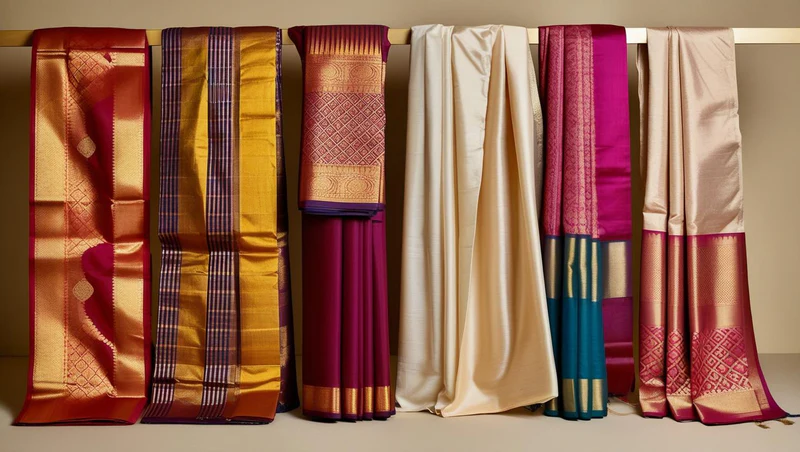
Pure silk sarees with real zari are built to last generations — but only with the right care
Real gold and silver zari oxidises on contact with air, moisture, or chemicals. The metallic lustre fades permanently without specialist intervention.
Silk stored in damp conditions develops fungal patches that destroy the fabric from the inside — nearly impossible to reverse once established.
Keeping a saree folded in the same position for years creates permanent crease lines that crack silk threads at the fold points.
Light exposure and chemical-based mothballs cause natural dyes to fade unevenly. Once faded, colour restoration is rarely possible.
This damage is slow — but permanent if ignored. A saree that looks fine today can be irreversibly damaged within 2–3 years of incorrect storage.
Which Situation Are You In?
Each situation has a different solution — choose yours belowMost saree owners fall into one of these situations. The wrong choice can cause permanent damage or permanent loss of value. Select your situation for the right path forward:
Option 1 — Store Your Sarees Properly
If cupboard space is the problemIf your cupboard is full, the worst thing you can do is leave the saree folded tightly in a plastic cover for months. This is how most saree damage happens — silently, invisibly, over time.
What to avoid completely
- ✕Stacking sarees tightly with pressure on the folds
- ✕Using plastic covers or airtight bags of any kind
- ✕Placing naphthalene balls directly touching the fabric
- ✕Ignoring for more than 6 months without refolding
- ✕Hanging silk sarees for extended periods
What to do instead
- ✓Wrap each saree individually in breathable cotton or muslin cloth
- ✓Store flat in a low-humidity, ventilated space away from sunlight
- ✓Refold along different lines every 3–6 months to prevent crease damage
- ✓Use neem leaves or silica gel sachets at the corners — never naphthalene on the fabric
- ✓Air the saree on a cool, flat surface for 30 minutes every few months
Proper storage alone can extend a pure silk saree’s usable life by 20–30 years. If you cannot store correctly at home, professional heritage storage is far better than a poorly packed cupboard.
Option 2 — Restore Old or Damaged Sarees
A saree that looks “finished” is often far from itMost visible damage — blackened zari, surface stains, dull colour, weakened fabric — can be addressed through professional restoration. A saree that looks old or abandoned may still carry significant value that can be recovered.
What restoration can fix
- ✓Zari tarnish and oxidation — stabilised and partially reversed
- ✓Surface dirt and stains — safely removed without damaging the weave
- ✓Weakened fabric structure — strengthened through professional conditioning
- ✓Fold damage — carefully relaxed and re-set by specialists
Send us a clear photo of your saree on WhatsApp. Our team will tell you honestly what restoration can and cannot fix — at no cost, before you commit to anything.
Option 3 — Reuse Old Sarees
Only if the saree is suitable — read this carefully firstIf you genuinely do not wear your saree and it carries no heirloom significance, converting it into another garment is valid. A suitable saree can become a lehenga, blouse, dupatta, or children’s outfit.
When you should NOT cut or reuse a saree
This is the decision most people later regret. Once cut, a saree can never be restored to its original form. Do not reuse if any of these apply:
- ✕It has heavy zari work — the border and pallu hold significant material value
- ✕It is a wedding saree or was gifted at an important occasion
- ✕It has emotional or family significance
- ✕It is a rare weave — Kanchipuram, Banarasi, Paithani, Mysore Silk
A heritage saree cut into a blouse loses 80–90% of its resale and heirloom value permanently. If unsure, always get expert advice before scissors touch the fabric.
Option 4 — Preserve as a Family Heirloom
The choice that protects both fabric and memorySome sarees are not meant to be worn daily. They are meant to be protected, maintained, and passed to the next generation. A properly preserved Kanchipuram saree can hold — or increase — its value over decades.
Preservation is the right choice when:
- ✓It was your mother’s or grandmother’s wedding saree
- ✓It was gifted at a significant family occasion
- ✓It is pure silk with real zari
- ✓You want your daughter or daughter-in-law to wear it one day
A pre-owned Kanchipuram fetches ₹3,000–₹8,000 at resale today. Properly preserved as a family heirloom, it carries far more — financially and emotionally — in your daughter’s hands a generation from now.
Common Mistakes That Destroy Silk Sarees
All of these cause irreversible damage — avoid them completelyThese mistakes are extremely common across Bangalore households. Each causes a different type of permanent damage to your saree:
Traps moisture and causes fungal growth. Silk must breathe. Never use plastic, even for short periods.
Direct contact causes chemical burns and permanently discolours zari. Use neem leaves or silica sachets at corners only.
The weight of a heavy zari saree stretches and weakens the fabric at hanger points over time. Always store flat.
Even moderate humidity in Bangalore’s monsoon months can cause fungal damage in poorly ventilated cupboards within weeks.
Harsh chemicals in commercial dry cleaning gradually weaken silk fibers. Heritage sarees need specialist gentle care.
Crease lines left unchanged for years crack silk threads at the fold — visible as permanent white lines across the saree.
What Should You Do With Your Saree?
Quick reference guide — find your situation and take the right action| Your Situation | Best Action | Do Not |
|---|---|---|
| Saree is damaged or stained | Restore professionally | Cut, sell, or attempt home cleaning |
| No cupboard space | Store properly in muslin | Pack in plastic and leave it |
| Don’t wear it anymore | Reuse if not heirloom quality | Cut a wedding or zari saree |
| Emotional or family value | Preserve as heirloom | Sell for short-term cash |
| Thinking of selling | Get expert assessment first | Sell without knowing true value |
| Unsure of condition | Send photo on WhatsApp — free | Make an irreversible decision alone |
Still unsure? Don’t guess. Every wrong decision with a heritage silk saree is permanent. A 5-minute WhatsApp conversation with our team costs nothing — and could save years of regret.
Get Free Expert Advice Before You Decide
Before you sell it, cut it, or store it the wrong wayOur team at Sthiraa Parampara has assessed hundreds of heritage silk sarees across Bangalore — Kanchipuram, Mysore Silk, Banarasi, Paithani and more. We know exactly what each saree needs, and we will tell you honestly.
Send us a photo on WhatsApp. Our response gives you a complete, clear assessment — free, with no obligation:
Send your saree photo.
Get an honest answer.
No pressure. No sales pitch. Just clear expert advice on what your saree actually needs — straight from our restoration team.
- Condition assessment — what the saree looks like right now
- Restoration possibility — what can be fixed and what cannot
- Storage advice — how to protect it correctly from today
- Preservation recommendation — if it is worth keeping as a heirloom
Quick · Practical · No guesswork · Free doorstep pickup across Bangalore